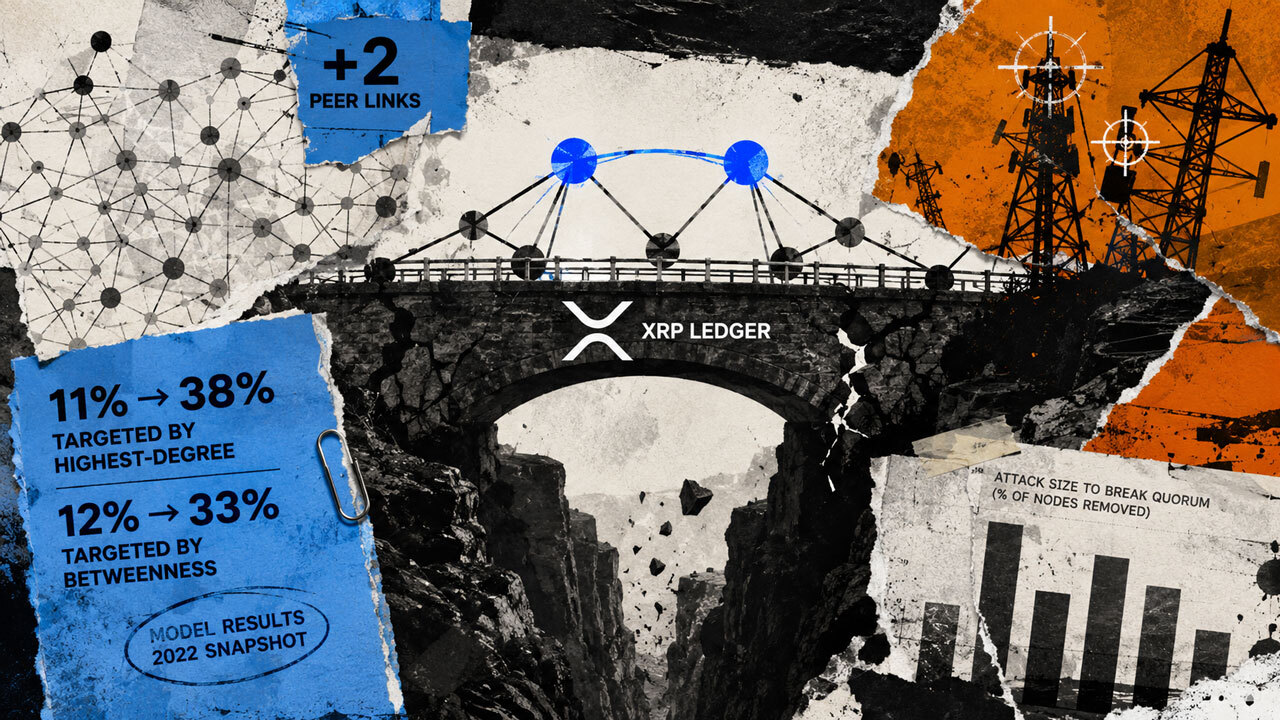
60% 참여율에서 두 개의 무작위 링크는 시뮬레이션된 정족수 실패 임계값을 11%에서 38%로, 12%에서 33%로 높였습니다.
새로운 XRP Ledger 연구에 따르면 참여 노드당 2~3개의 추가 피어 연결이 모델링된 합의를 방해하기 위해 표적 공격이 제거해야 하는 노드 수를 급격히 늘릴 수 있다고 합니다.
XRPL 합의는 서로의 메시지를 수신하는 충분히 신뢰할 수 있는 검증인에 달려 있습니다. 별도의 P2P 네트워크가 서버 간에 이러한 메시지를 전달하므로 공격으로 인해 네트워크에서 가장 바쁜 허브가 제거되는 경우 추가 경로를 통해 유효성 검사기 트래픽이 계속 이동할 수 있습니다.
8월 26일 Xiv에서는 무작위 K-out 증강을 종이 테스트했습니다. K는 각 참여 노드가 무작위로 균일하게 선택된 피어에 대해 생성하는 새로운 방향이 지정되지 않은 가장자리의 수입니다.
참여도가 60%이고 K=2인 경우 제거가 가장 높은 수준의 노드를 표적으로 삼았을 때 모델의 정족수 중요 공격 규모는 11%에서 38%로 증가했습니다. 다수의 최단 경로에 있는 노드에 우선순위를 부여하는 매개 중심성(Betweenness Centrality)에 따른 공격에서 임계값은 12%에서 33%로 증가했습니다.
두 번째 변화는 기준선의 2. 75배입니다. 이 지표는 모델 유효성 검사기의 80% 미만이 하나의 연결된 구성 요소에 함께 남아 있기 전에 제거된 노드의 시뮬레이션된 비율을 측정합니다. 관찰된 공격 비용은 아직 알려지지 않았습니다.
80% 및 100% 참여에서 K=3은 논문의 네트워크 및 쿼럼 테스트 전반에 걸쳐 보다 침입적인 재배선 전략을 약 20~25회 반복하여 생성된 모델링된 견고성과 일치하거나 이를 초과했습니다. K-out 증대는 원래 엣지 세트와 약 0. 85 Jaccard 유사성을 유지한 반면 재배선은 0. 5보다 훨씬 낮았습니다.
비교를 통해 그래프 수준 결과가 확립됩니다. 균일하게 분산된 소수의 링크는 반복되는 에지 교체보다 원래 네트워크를 더 많이 보존하면서 대체 경로를 생성할 수 있습니다. 저자는 또한 선택한 입력에 대한 시뮬레이션 코드와 스냅샷 파일을 공개했습니다.
이 연구는 2022년 두 달 동안 수집된 시간별 스냅샷 1, 290개를 재사용합니다. 데이터세트의 평균 특성에 가장 가까운 그래프를 선택하여 노드 952개, 모서리 15, 070개, 평균 차수가 31인 대표적인 스냅샷을 생성합니다. 7.
또한 해당 역사적 지도는 시작 임계값을 고정합니다. 2026년 8월 논문에 따르면 이전의 견고성 연구에서 노드의 약 20%를 목표로 제거하면 네트워크 견고성이 손상되고 약 9%는 쿼럼 견고성이 손상되는 것으로 나타났습니다. 무작위 오류로 인해 훨씬 더 많은 제거 작업이 필요했습니다. 모든 백분율은 이전 그래프의 공격 시뮬레이션을 설명합니다.
유효성 검사기 배치는 두 번째 추상화를 도입합니다. 데이터 세트는 검증자를 식별하지 않았으므로 각 주요 시뮬레이션은 34개의 검증자 노드를 무작위로 균일하게 선택하고 직접 타겟팅에서 제외했습니다. 검증인 할당을 위해 높은 수준 또는 낮은 수준의 노드를 선호하는 민감도 테스트는 기준 및 증분 이득이 변경되었음에도 불구하고 무작위 확대의 질적 이점을 유지했습니다.
현재 네트워크는 다양한 가시 입력을 제공합니다. 8월 30일, Bithomp의 라이브 노드 탐색기에는 786개의 검색 가능한 노드가 표시되었으며, 유효성 검사기 보기에는 표시된 XRP Ledger Foundation UNL에 35개의 회원이 표시되었습니다. 라이브 카운트는 시간이 지남에 따라 변하며 종이의 크롤링 방법이 아닌 타사 측정을 통해 제공됩니다. 비교를 통해 입력이 변경되었음을 확인합니다. 현재 회복력의 방향은 아직 해결되지 않은 상태로 남아 있습니다.
원문 제목: XRPL consensus freezes after removing just 12% of central nodes – but a simple tweak triples XRP defense
At 60% participation, two random links raised simulated quorum-failure thresholds from 11% to 38% and 12% to 33%.
A new XRP Ledger study says two or three extra peer connections per participating node can sharply raise the number of nodes a targeted attack must remove to disrupt modeled consensus.
XRPL consensus depends on enough trusted validators receiving one another’s messages. A separate peer-to-peer network carries those messages between servers, so extra routes could keep validator traffic moving if an attack removes the network’s busiest hubs.
TheAug. 26 arXiv papertests random K-out augmentation. K is the number of new undirected edges each participating node creates to peers chosen uniformly at random.
At 60% participation and K=2, the model’s quorum critical attack size rose from 11% to 38% when removals targeted the highest-degree nodes. Under an attack ordered by betweenness centrality, which prioritizes nodes that sit on many shortest paths, the threshold rose from 12% to 33%.
The second change is 2.75 times the baseline. The metric measures the simulated share of nodes removed before fewer than 80% of the model’s validators remain together in one connected component. Observed attack cost remains unknown.
At 80% and 100% participation, K=3 matched or exceeded the modeled robustness produced by roughly 20 to 25 iterations of a more invasive rewiring strategy across the paper’s network and quorum tests. K-out augmentation retained about 0.85 Jaccard similarity with the original edge set, while rewiring fell well below 0.5.
The comparison establishes a graph-level result: a small number of uniformly distributed links can create alternate paths while preserving more of the original network than repeated edge replacement. The authors also released theirsimulation code and snapshot filesfor the chosen inputs.
The study reuses 1,290 hourly snapshots collected over two months in 2022. It selects the graph closest to the dataset’s average characteristics, producing a representative snapshot with 952 nodes, 15,070 edges and average degree 31.7.
That historical map also anchors the starting thresholds. The Aug. 2026 paper says prior robustness work found that targeted removal of about 20% of nodes compromised network robustness, while about 9% compromised quorum robustness. Random failures required far larger removals. Every percentage describes an attack simulation on the old graph.
Validator placement introduces a second abstraction. The dataset did not identify validators, so each main simulation selected 34 validator nodes uniformly at random and excluded them from direct targeting. Sensitivity tests that favored either high-degree or low-degree nodes for validator assignment preserved the qualitative advantage of random augmentation, although the baseline and incremental gains changed.
The current network supplies different visible inputs. On Aug. 30,Bithomp’s live node explorerdisplayed 786 discoverable nodes, while its validator view showed 35 members on the displayed XRP Ledger Foundation UNL. The live count changes over time and comes from a third-party measurement rather than the paper’s crawl method. The comparison establishes that the inputs have changed; the direction of present-day resilience remains unresolved.