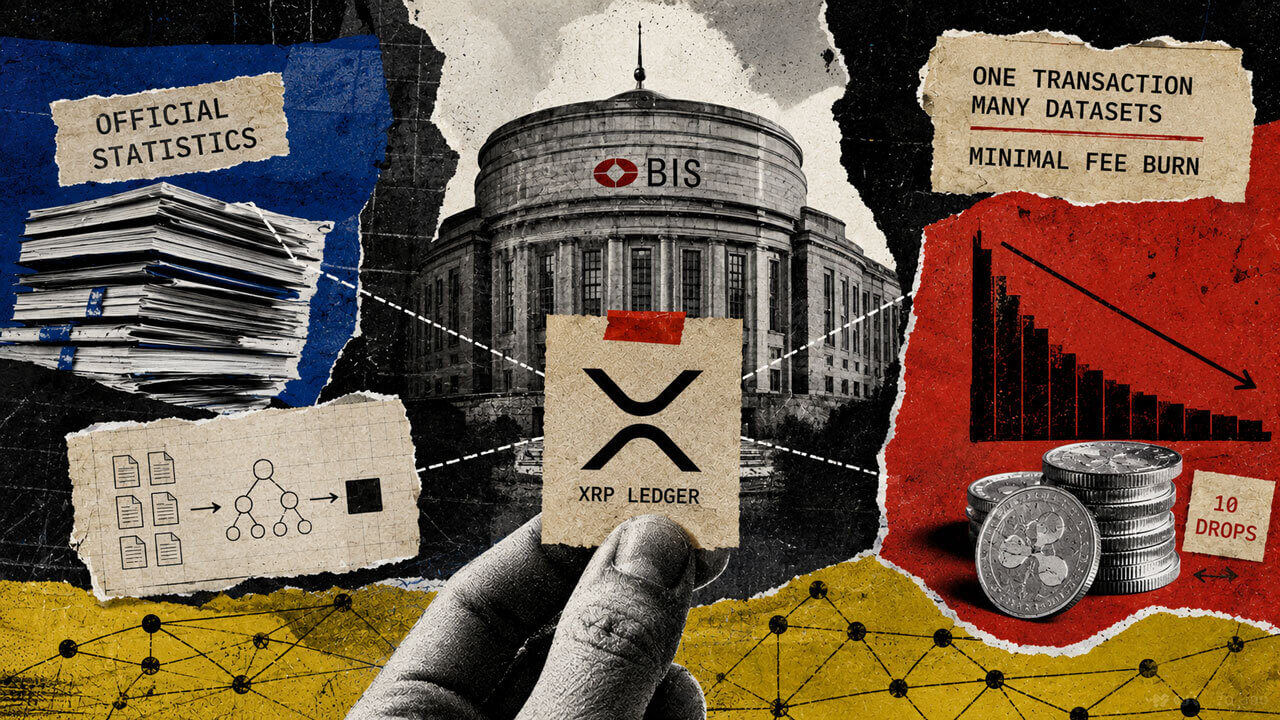
한 번의 거래로 수천 개의 데이터 세트를 인증할 수 있으므로 기관 스타일의 사용량이 늘어나더라도 수수료 소모는 최소화됩니다.
국제결제은행(Bank for International Settlements)은 공식 통계의 진위 여부를 확인하기 위한 프로토타입을 설명하는 작업 보고서를 9월 2일 발표했습니다. 시스템은 통계 파일을 암호화 지문으로 변환하고 해당 지문 요약을 XRP Ledger에 고정하며 수신자가 파일을 공개 기록과 비교할 수 있도록 합니다.
그 결과 XRP에 대한 분할 평결이 생성됩니다. 프로토타입은 XRPL에 신뢰할 수 있는 기관 스타일 사용 사례를 제공하는 동시에 일괄 처리 설계로 직접적인 수수료 소진 경로를 기계적으로 작게 유지합니다. 하나의 원장 트랜잭션은 수천 개의 데이터 세트를 나타낼 수 있으므로 유용한 활동은 XRP를 소비하는 트랜잭션 수보다 훨씬 빠르게 확장될 수 있습니다.
이 연구는 8월 1일 SAGE를 통해 온라인에 처음 게재되었습니다. 9월 2일에 BIS Working Paper 1374가 발표되었습니다. 이 논문은 저자의 견해를 제시하고 기업과 프로젝트에 대한 언급이 예시적이라고 말합니다. 구현은 실험적인 XRPL Dev Net 개념 증명으로 남아 있으며 검토된 소스에서는 Ripple과의 상업적 관계를 공개하지 않습니다.
공식 통계는 일반적으로 통계 데이터 및 메타데이터 교환 표준인 SDMX를 통해 이동됩니다. 프로토타입은 SDMX 파일을 정규화하고 SHA3-512 해싱을 전체 파일 또는 개별 데이터 시리즈에 적용합니다. 그런 다음 대규모 레코드 그룹을 루트라고 하는 하나의 요약 값으로 압축하는 구조인 Merkle 트리에서 이러한 지문을 결합합니다.
루트는 XRPL 트랜잭션의 메모 필드에 기록됩니다. 기본 통계와 프로토타입의 운영 저장소 및 증명은 오프체인 상태로 유지됩니다. 반환된 SDMX 파일에는 거래 참조, 주문된 지문, 서명된 검증 가능한 자격 증명이 포함되어 수신자에게 루트를 재구축하고 이를 원장과 비교하는 데 필요한 자료를 제공합니다.
따라서 XRPL은 약속에 대한 타임스탬프가 있는 공증인 역할을 합니다. 이는 경제 수치를 보유하는 데이터베이스 역할을 하지 않습니다. 오픈 소스 구현은 실험적이며 생산에 적합하지 않으며 유지 관리되지 않는다고 설명합니다.
저자는 낮은 명목 수수료, 빠른 합의 최종성 및 접근 가능한 개발자 리소스를 위해 XRPL을 선택했습니다. 또한 블록체인 인터페이스를 교체 가능하게 만들어 다른 원장이 동일한 고정 역할을 수행할 수 있도록 했습니다. 이러한 설계 선택은 해당 방법이 XRP Ledger에 의존한다는 증거가 아니라 인증 방법과 XRPL의 호스팅 능력에 대한 프로토타입 증거를 만듭니다.
성능 결과는 XRPL Dev Net에 연결되고 합성 SDMX 코퍼스를 사용하는 단일 개발자 워크스테이션에서 나왔습니다. 이러한 통제된 테스트에서 게시 지연 시간 중앙값은 3~5초였고 확인에는 1~2초가 걸렸습니다. 평가에서는 지속적인 메인넷 로드, 기업 방화벽, 하드웨어 보안 모듈 지원 서명 및 적대적인 조건을 제외했습니다. Dev Net은 실제 가치가 없는 테스트 XRP를 사용하므로 실제 토큰 수요 대신 기술적 측정이 생성되었습니다.
그 경계는 여전히 의미 있는 결과를 남긴다. 통계 게시자는 공개 원장에 기밀 데이터를 노출하지 않고도 독립적인 무결성 검사를 제공할 수 있습니다. 경제적 균형은 동일한 메커니즘에서 나타납니다. Merkle 일괄 처리는 대량의 정보를 인증하는 데 필요한 온체인 약속의 수를 줄입니다.
암호화폐 Slate의 편집자가 해독한 암호화폐 이야기 움직이는 시장으로 하루를 시작하세요.
이메일 하나. 중요한 모든 것.
원문 제목: BIS shows why real institutional adoption on XRP Ledger won’t trigger the XRP supply squeeze holders expect
One transaction can authenticate thousands of datasets, leaving fee burn tiny even as institutional-style usage scales.
The Bank for International Settlements released a working paper on Sept. 2 describing a prototype for checking the authenticity of official statistics. The system turns a statistical file into a cryptographic fingerprint, anchors a summary of those fingerprints on XRP Ledger, and lets a recipient compare the file with the public record.
The result creates a split verdict for XRP. The prototype gives XRPL a credible institutional-style use case, while its batching design keeps the direct fee-burn pathway mechanically small. One ledger transaction can represent thousands of datasets, so useful activity can scale much faster than the number of transactions consuming XRP.
The research first appeared online through SAGE on Aug. 1; Sept. 2 marks its release asBIS Working Paper 1374. The paper presents the authors' views and says its references to firms and projects are illustrative. Its implementation remains an experimental XRPL DevNet proof of concept, and the reviewed sources disclose no commercial relationship with Ripple.
Official statistics commonly travel in SDMX, a standard for exchanging statistical data and metadata. The prototype normalizes an SDMX file and applies SHA3-512 hashing to the whole file or to individual data series. It then combines those fingerprints in a Merkle tree, a structure that compresses a large group of records into one summary value called a root.
The root is written into the memo field of an XRPL transaction. Underlying statistics and the prototype's operational stores and proofs stay off-chain. The returned SDMX file embeds the transaction reference, ordered fingerprints, and a signed verifiable credential, giving a recipient the material needed to rebuild the root and compare it with the ledger.
XRPL therefore serves as a timestamped public notary for the commitment. It does not serve as the database holding the economic figures. Theopen-source implementationdescribes itself as experimental, unsuitable for production, and unmaintained.
The authors selected XRPL for low nominal fees, fast consensus finality, and accessible developer resources. They also made the blockchain interface replaceable, so another ledger could perform the same anchoring role. That design choice makes the prototype evidence for the authentication method and for XRPL's ability to host it, rather than evidence that the method depends on XRP Ledger.
Performance results came from a single developer workstation connected to XRPL DevNet and using a synthetic SDMX corpus. In those controlled tests, median publication latency was three to five seconds and verification took one to two seconds. The evaluation excluded sustained Mainnet load, an enterprise firewall, hardware-security-module-backed signing, and adversarial conditions. DevNet uses test XRP with no real-world value, so the run produced technical measurements instead of live token demand.
Those boundaries still leave a meaningful result. A statistical publisher could provide an independent integrity check without exposing confidential data on a public ledger. The economic trade-off appears in the same mechanism: Merkle batching reduces the number of on-chain commitments needed to authenticate a large body of information.
Start your day with the crypto stories moving markets, decoded by CryptoSlate’s editors.
One email. Everything that matters.